
On the eve of his visit to Japan, Prime Minister Manmohan Singh spoke to the Japanese media on the agenda of his visit. This is an excerpt

Prime Minister Narendra Modi addressed his Japanese counterpart Sanae Takaichi as his 'younger sister' and hailed her as a 'visionary and popular leader' during a joint press meet, where both leaders unveiled initiatives to deepen bilateral cooperation and strengthen the India-Japan Special Strategic and Global Partnership.

Notwithstanding the economic complementarities and the host of agreements for deepening economic relation on a host of areas, both sides share common viewpoints on the foreign policy domain and seek common grounds to serve as a counterweight to China, notes Dr Rajaram Panda.
The joint statement issued by Dr Singh and PM Abe in Tokyo.

The visit was expected to project Assam as the gateway to Southeast Asia and reinforce the state's emergence as a preferred investment destination.

India and Japan have signed a Memorandum of Arrangement on maritime security cooperation, committing to deepen defence ties and oppose unilateral actions that impede freedom of navigation in the Indo-Pacific, a move seen as directed at China's increasing military presence.

In a region increasingly shaped by competition and coercion, such collaboration strengthens security without confrontation, builds capacity without dependency and promotes order without domination, points out Dr Kumar.

Indian stock market benchmark indices Sensex and Nifty closed nearly one per cent higher, extending their winning streak for a second day. This rally was driven by softening crude oil prices, positive geopolitical developments, and significant buying in blue-chip IT stocks, despite a broader global tech sell-off.

History may remember Takaichi Sanae not as the leader who simply accelerated Japanese rearmament, but as one who governed during Japan's transition from an industrial-age security model to a post-industrial strategic member of the global order, points out Varun Arya.

As Japan beefs up its defences against China, both New Delhi and Tokyo seem to have decided to re-energise their relationship to ensure a strategic balance in Asia. It is a clear signal that they may be ready to work together in containing if not confronting China, says Nitin Gokhale.
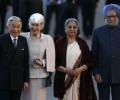
In recent years India-Japan relations have acquired rich economic content and strategic intents. Although the bilateral trade at $18 billion between the two countries is not very impressive and leaves much to be desired, the economic engagement between the two countries is both qualitatively and quantitatively noteworthy. India-Japan defence cooperation, however, has generated a lot interest among the strategic community in the context of rise of China. There has been a lot of speculation about India-Japan strategic partnership to hedge China, says Rup Narayan Das.
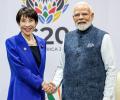
If they act now, they can reshape the strategic map of Asia without firing a shot. If they wait, the next opportunity will come only after a serious Taiwan Strait incident -- by which time the price will be far higher, and the room for boldness far smaller -- the opportunity may well be lost by then. The question is no longer whether this can or should be done, points out Varun Arya.

The compulsion behind India and Japan to deepen security cooperation is in response to China's growing political and economic clout and its assertive behaviour in disputed areas. This has been the key driver for bringing both India and Japan closer in the domain of security cooperation, explains Dr Rajaram Panda.
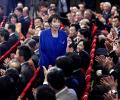
As a protege of Shinzo Abe, Takaichi is expected to scale bilateral ties much higher. Trade and investment shall grow. People-to-people contacts shall be scaled up, points out Dr Rajaram Panda.
.jpg)
India and Japan on Monday agreed to enhance their defence and strategic cooperation to a new level during talks between Prime Minister Narendra Modi and his counterpart Shinzo Abe, who also decided to speed up negotiations on civil nuclear deal that could not be concluded now.

Japan is expected to increase its investment target in India from the earlier 5 trillion yen ($34 billion) to almost 10 trillion yen.

India and Japan on Thursday agreed to enhance military exercises and defence cooperation as the two countries emphasised that the bilateral special strategic and global partnership plays a crucial role in ensuring a free, open and rules-based Indo-Pacific, amidst China's aggressive behaviour in the region.

Prime Minister Narendra Modi and his Japanese counterpart Yoshihide Suga met in Washington, DC, on Thursday to discuss ways to further cement the bilateral strategic ties ahead of the first in-person Quad meeting to be hosted by US President Joe Biden.
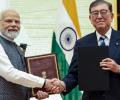
India and Japan have unveiled a comprehensive framework to boost their defence cooperation in response to security challenges, particularly concerning China's increasing military presence in the East and South China Seas.
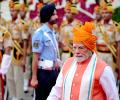
Prime Minister Narendra Modi will travel to China to attend the Shanghai Cooperation Organisation (SCO) summit, marking his first visit in over seven years. The visit signals a potential improvement in India-China relations after recent tensions.

Prime Minister Modi, who is in Japan on a two-day visit to attend a summit of the Quad leaders at the invitation of his Japanese counterpart Fumio Kishida, penned an op-ed on the vibrant relations between India and Japan in the Yomiuri Shimbun.
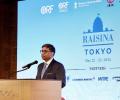
India's Foreign Secretary Vikram Misri has underscored the importance of not equating the victims and perpetrators of terror attacks, highlighting the need for global unity in combating terrorism. Speaking at Raisina Tokyo 2025, Misri expressed appreciation for Japan's support following the recent terror attack in Pahalgam, India. He also cautioned against the trend of some Western countries hyphenating India and Pakistan in the context of their recent military confrontation. Misri further outlined India's economic aspirations and its commitment to becoming a factor of stability in a turbulent world.
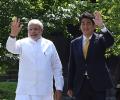
Although the India-Japan relationship has its own driving forces in terms of robust economic ties and shared values, China is the elephant in the room in the strategic parleys between the two countries, says Rup Narayan Das.
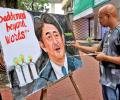
Prime Minister Narendra Modi will join several global leaders to pay tributes to Japan's slain former prime minister Shinzo Abe at his state funeral in Tokyo on Tuesday.
During his talks and public speeches, Mukherjee urged Japan to look at India's "impeccable" non-proliferation record and back the Indo-US civilian nuclear agreement at the Nuclear Suppliers Group meeting.
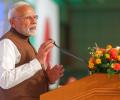
Showcasing India as an attractive investment destination, Modi said the country has political and economic stability as well as transparency and predictability in policy decisions.
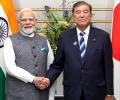
Prime Minister Shigeru Ishiba's sudden resignation after only a year in office has thrown Japan into political turmoil, raising doubts about how the country will handle economic and regional challenges, observes Dr Rajaram Panda.
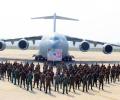
Dharma Guardian 2025 will primarily focus on urban warfare tactics and counter-terrorism operations and underscores the growing strategic partnership between India and Japan.

Biden has been under attack from his opponents and the Republican Party for his immigration policies as hundreds and thousands of illegal immigrants enter the United States every month.
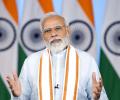
He said he will be visiting Tokyo at the invitation of his Japanese counterpart Fumio Kishida, and noted that in March 2022, he had hosted Kishida for the 14th India-Japan Annual Summit.
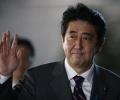
Prime Minister of Japan Shinzo Abe will pay a three-day official visit to India from January 25 during which he will attend the Republic Day Parade as Chief Guest and hold talks on key issues with his Indian counterpart Manmohan Singh for the bilateral annual summit.

Prime Minister Narendra Modi on Tuesday offered a floral tribute to former Japanese premier Shinzo Abe at his state funeral in Tokyo.

An India-Japan joint statement said the two leaders expressed serious concern over the conflict and the unfolding humanitarian crisis in Ukraine.
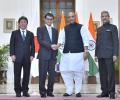
The India-Japan 2+2 dialogue added strategic heft to the special relationship in the wake of growing Chinese assertiveness on regional affairs, points out Dr Rajaram Panda.

'Landed in Tokyo. Will be taking part in various programmes during this visit including the Quad Summit, meeting fellow Quad leaders, interacting with Japanese business leaders and the vibrant Indian diaspora,' Modi tweeted in both Japanese and English.
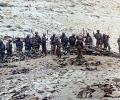
In the 15-year dataset, the researchers noted an average of 7.8 incursions per year even though the Indian government's estimates are much higher.

This will serve as framework for Smart heritage city programme between the two countries
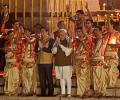
With a 'tilak' on his forehead and a 'puja thali' in his hands, Shinzo Abe's picture attending the 'Ganga aarti' alongside Prime Minister Narendra Modi at the fabled Dashashwamedh Ghat in Varanasi in 2015 symbolised his 'India connect' and reflected the very special bond he shared with the country.

The India-Japan joint naval exercises are a strategic signal for China, observes Dr Rajaram Panda.

The India-Japan global partnership is based on shared democratic values and respect for the rule of law and promotes peace and stability in the Indo-Pacific, Prime Minister Narendra Modi said on Monday after holding wide-ranging talks with his Japanese counterpart Fumio Kishida.
